The best walking treadmills for seniors prioritize safety with extended handrails, ultra-slow starting speeds (0.2-0.5 MPH), and emergency stop features while supporting 300-400 pound weight capacities. After analyzing 18+ models, the best walking treadmill for seniors is the Redliro 400lb Capacity Model ($549.99) with dual extended handrails, 0.3 MPH ultra-slow starting speed, and 47.6″ extended belt. For budget-conscious buyers, the Yesoul Walking Treadmill at $269.99 delivers essential safety features with exceptional value including a 50″ belt, 6-layer shock absorption, and remote control at exceptional value.
The best walking treadmill for seniors depends on individual needs, budget, and physical condition.
Best Overall: Redliro 400 lb Capacity ($549.99) delivers every critical safety feature including dual handrails, 0.3 MPH start, 47.6″ extended belt, and rock-solid 400-pound construction. Worth the premium for users over 250 pounds, those in serious recovery, or anyone prioritizing maximum safety and stability.
Best Value: Yesoul Budget Model ($269.99) provides exceptional value with a 50″ belt, 6-layer shock absorption, remote control, app connectivity, and all essential safety features. Perfect for budget-conscious seniors who primarily walk at moderate speeds.
Best for Recovery: Exerpeutic 400 lb ($459.00) offers the slowest 0.2 MPH start, full-length handrails with extra forward position, and simplified controls backed by 15-year American brand support. Ideal for post-surgery rehabilitation and serious mobility limitations.
Best Premium Features: BSJ BESTGYM ($309.99) delivers 3.5 HP power, no-assembly convenience, APP control, and spacious running area at a mid-range price. Best for tech-savvy seniors wanting performance without premium pricing.
Best Innovation: FYC Forward/Reverse ($399.99) provides unique bidirectional walking for balance improvement, dual shock absorption, pulse-sensing handle, and SGS certification with 2-year guarantee.
Price Range Guidance
Under $300: Yesoul Budget ($269.99) offers genuine value; avoid ultra-budget under $100
$300-$400: Sweet spot offering quality construction, safety features, and reliability for most seniors
$400+: Justified for 400 lb capacity needs, ultra-slow speeds (0.2-0.3 MPH), premium features, or maximum longevity
Final Decision Factors
Prioritize safety above all else. Extended handrails, emergency stops, and appropriate starting speeds prevent injuries that cost more than any price difference between models.
Match features to actual needs. Don’t overpay for app connectivity if technology feels overwhelming. Don’t buy walking-only (3.8 MPH max) if family members want jogging capability.
Consider long-term value. A $549 treadmill lasting 8 years costs $69/year. A $269 model lasting 3 years costs $90/year. Quality often delivers better value despite higher initial cost.
Test before buying when possible. Visit retailers to try handrail heights, belt feel, and control accessibility. Many accommodate senior testing.
Read customer reviews carefully. Focus on reviews from verified senior users. Note assembly difficulty, noise levels, and customer service experiences.
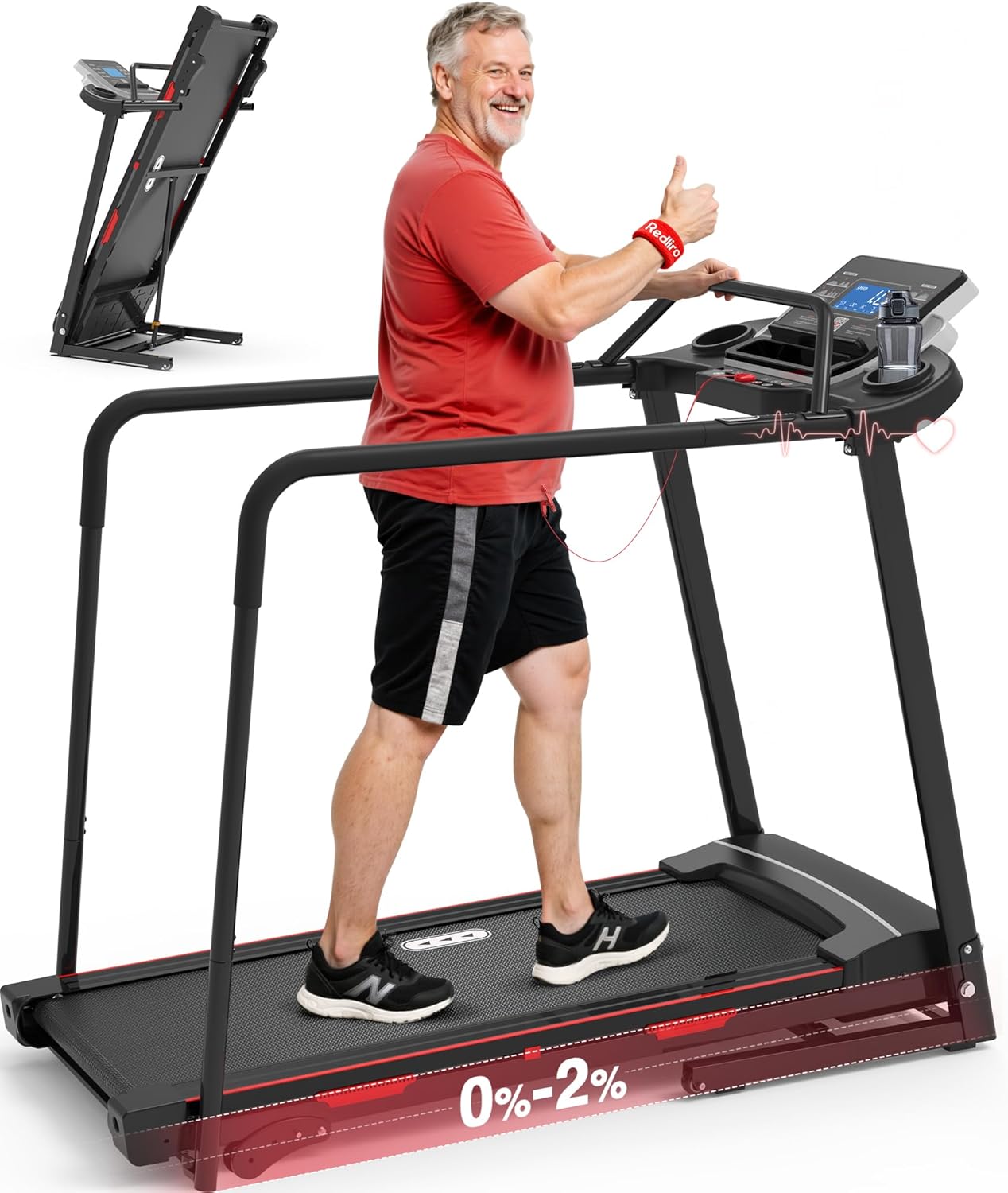
•【Front & Side Long Handrails 】Unlike basic treadmills with short, flimsy rails, Redliro senior-friendly treadmill features extra-long side handrails and a sturdy front bar, creating double safety support
•【0.3Mph Start + 0%-2% Incline】Redliro foldable home treadmill starts at a gentle 0.3MPH—slower than most treadmills—making it perfect for seniors or users in recovery. With precise 0.1MPH adjustments, you can easily find your ideal pace for walking, rehab, or light jogging. The 0–2% incline adds a mild challenge when needed, while the smooth, joint-friendly design keeps every step safe and steady.
•【Simple to Use】Our Senior Treadmill’s console is made for easy use and clear info. It has a dual-data display with key details (heart rate, time, speed, distance, calories) in big, easy to read numbers—checkable while walking. The console also has extra speed shortcuts, mute, and a screen-off button (great for short pauses).
•【400LBS Capacity & 47.6”Long Belt】The Redliro walking treadmill with incline features a 47.6" x 16.5" extra-long belt and supports up to 400 lbs. Its wide, reinforced deck offers more stride space and stability—perfect for tall or heavy users who need secure, steady support. Ideal for indoor walking, light rehab, or daily exercise, it keeps you balanced and confident every step of the way.
•【Foldable & Move Wheels】After your workout, fold it down effortlessly with the soft-drop system—no heavy lifting or strain required. Remove the two handrails to make it even more compact, ideal for small apartments or offices. With 2 move wheels, you can easily roll it from your living room to your workspace for a quick walk, then tuck it neatly away.
• SAFETY HANDRAILS: Our treadmill's full-length assistant handrails provide safe, easy-fitness walking. The foam padding on the handlebars is soft and easy to grip during a session. We include an extra forward position hand rail for users wanting additional safety
• HEAVY-DUTY: This treadmill features 6 shock-absorbing deck cushions with extra reinforcement to reduce joint impact while walking. The machine itself can handle up to 400 lb. of weight
• BACKLIT LCD AND ACCESSORY HOLDERS: The treadmill's highly visual display window features elapsed time, distance walked, calories burned, speed, and pulse. The two pockets built into either side of the display hold keys, phones, and other accessories
• LOW SPEED: The speed settings begin at 0.3 MPH and adjust in increments of 1/10 MPH up to a maximum of 4 MPH. These settings allow you to move at your own pace and take things slow
• LONGER & WIDER BELT- Our 43.5" x 16" belt offers superior comfort and is the perfect size for taller users. Larger walking area than most others.
• SIMPLIFIED COMPUTER USE- Purposefully designed to be easy to use. Start, Stop, Speed Up/Down. Great for those who are older or have trouble figuring out complicated electronics.
• MANUAL INCLINE- Treadmill can be put at an incline to simulate walking up a gentle slope
•【Long Handrails & Safety Key】This senior-friendly treadmill features ergonomically designed detachable long armrests, providing enhanced stability and support during walking to minimize fall risks. • Specifically engineered for seniors, rehabilitation users, and individuals with balance challenges, the system incorporates an emergency safety mechanism: power immediately shuts off if the magnetic safety key becomes disengaged, ensuring user safety.
•【Powerful Motor & Adjust Speeds】Designed to accommodate seniors and convalescents with diverse exercise needs, the BESTGYM treadmill features a robust 3.5 HP motor. the speed can be freely adjusted from 0.6 to 7.5 mph to meet different needs such as walking and jogging. The well-designed speed +/-, and start/stop shortcut buttons,and heart rate sensor on the armrests are very practical
•【Improve Running Experience】The LED display clearly shows time, calories, steps, speed, and distance. The walking pad utilizes a 6-layer running belt with enhanced durability. Its spacious 43.3×16-inch running area accommodates users of different body shapes, while stable construction ensure safety. The running belt’s special texture increases friction to prevent slipping, provides all-around joint protection, and reduces fatigue during prolonged exercise. Supports up to 300 lbs.
•【Personalize Workout with App】Through the APP control.Can simulate different scenarios and training methods.When running, exercise data such as time, speed, and calorie consumption will be displayed in real time
Our Top Picks: Best Walking Treadmills for Seniors Ranked
1. Best Overall: Redliro Walking Treadmill with Front & Long Handrails (400 lb)
Price: $549.99 (list price)
The Redliro 400 lb capacity treadmill leads our rankings because it combines every critical safety feature seniors need with superior build quality.
Complete Specifications:
Weight Capacity: 400 pounds
Belt Size: 47.6″ L x 16.5″ W (longest in class)
Speed Range: 0.3-7 MPH
Motor: 2.5 HP
Incline: 0-2% adjustable
Dimensions: 57.1″D x 26.4″W x 47.2″H
Weight: 94.3 pounds
Display: Dual-data LCD with large numbers
Special Features: Front bar + extended side rails, soft-drop folding, auto-lubrication
Why This Ranks #1:
This model earns the top spot for three reasons. First, the 400-pound capacity means reinforced construction that provides stability even for lighter users. Second, the 0.3 MPH starting speed is slower than 90% of competitors—critical for rehabilitation. Third, the dual handrail design (front bar plus long side rails) offers unmatched support.
Pros:
Slowest start speed (0.3 MPH) for maximum safety
Longest belt (47.6″) accommodates tall users
Front handrail plus side rails create full support system
400 lb capacity ensures rock-solid stability
Soft-drop folding requires no heavy lifting
Console buttons for easy operation without bending
Sleep mode button eliminates need to reach power switch
Cons:
Heaviest model at 94 pounds (harder to move)
Highest price point ($549.99)
Assembly required (approximately 45 minutes)
Large footprint when unfolded
Best For: Seniors in recovery, users over 250 pounds, tall individuals needing extra belt length, anyone prioritizing maximum safety features.
2. Best Heavy-Duty: Exerpeutic Senior Fitness Treadmill (400 lb)
The Exerpeutic earns second place with its American brand reliability and the slowest starting speed available.
Complete Specifications:
Weight Capacity: 400 pounds
Belt Size: 43.5″ L x 16″ W (wider than most)
Speed Range: 0.2-4 MPH
Motor: 2.5 HP
Incline: Manual adjustment available
Dimensions: 53″D x 26″W x 43″H
Weight: 71 pounds
Display: Backlit LCD
Special Features: Full-length assistant rails, forward position extra rail, 6 shock absorbers
Why This Ranks #2:
Exerpeutic’s 15-year brand history and 0.2 MPH start speed (slowest available) make this ideal for serious recovery work. The full-length handrails span the entire deck, providing continuous support. The American company offers superior customer service compared to international brands.
Pros:
Absolute slowest start at 0.2 MPH
Extra forward handrail position for additional safety
6 shock-absorbing cushions with extra reinforcement
Best For: Post-surgery recovery, limited mobility users, seniors who need the slowest possible speeds, buyers who value American brand support.
3. Best Premium Features: BSJ BESTGYM Walking Treadmill
Price: $309.99
This model ranks third by delivering premium features at a mid-range price point.
Complete Specifications:
Weight Capacity: 300 pounds
Belt Size: 43.3″ L x 16″ W
Speed Range: 0.6-7.5 MPH
Motor: 3.5 HP (highest in class)
Incline: None
Dimensions: 52″D x 26.8″W x 45.3″H
Weight: 75 pounds
Display: LCD with LED backlighting
Special Features: No assembly required, detachable long armrests, 6-layer belt, APP control
Why This Ranks #3:
The 3.5 HP motor provides the most power at this price level. No assembly required means seniors can use it immediately. APP control with scenario simulation adds engagement for tech-comfortable users.
Most powerful motor (3.5 HP) ensures quiet operation
No assembly required—unbox and use
Detachable armrests offer flexibility
Wide 43.3″ x 16″ running area
Heart rate sensors on armrests
Speed controls on handrails
APP connectivity with virtual scenarios
Competitive $309.99 price for features offered
Cons:
Higher 0.6 MPH start speed (less ideal for recovery)
No incline option
300 lb capacity (not heavy-duty)
Limited brand recognition
Best For: Tech-savvy seniors, multiple family members sharing one treadmill, users wanting powerful performance without assembly hassle.
4. Best Ultra-Slow Start: Redliro Treadmill for Seniors (0.3 MPH – Foldable)
Price: $459.99 (list price)
This model ranks fourth for its rehabilitation-focused design and maintenance-free features.
Complete Specifications:
Weight Capacity: 300 pounds
Belt Size: 41″ L x 16″ W
Speed Range: 0.3-5.5 MPH
Motor: 2.5 HP
Incline: 3-level manual adjustment
Dimensions: 48.4″D x 25.2″W x 46.4″H
Weight: 67.5 pounds
Display: LED
Special Features: Dual handrails (side + front), self-lubricating deck, gas spring folding
Why This Ranks #4:
The dual handrail system (side rails plus front bar) combined with 0.3 MPH start makes this perfect for rehabilitation. Self-lubricating deck eliminates maintenance hassles that frustrate seniors.
Pros:
0.3 MPH start speed matches top-tier models
Front bar plus side rails for complete support
Self-lubricating deck with easy oil port access
3-level incline adjustable via pin system
Gas spring folding assist
Built-in speed controls on handrails
Pulse sensors for heart rate monitoring
Folded size: 51.2″ x 27.4″ x 9.4″
Cons:
Standard 300 lb capacity
$459.99 price approaches heavy-duty models
Shorter belt (41″) than premium options
Assembly required
Best For: Rehabilitation patients, seniors with joint concerns, users wanting zero-maintenance operation, those needing front handrail support.
5. Best Forward/Reverse: FYC Walking Treadmill with Pulse Sensors
This unique model ranks fifth for its innovative bidirectional walking capability.
Complete Specifications:
Weight Capacity: 300 pounds
Belt Size: 39.4″ L x 15.4″ W
Speed Range: 0.5-6 MPH
Motor: 2.5 HP
Incline: 1.1-2.5% adjustable
Dimensions: 47.6″D x 24.8″W x 46.5″H
Weight: 64 pounds
Display: LED with large fonts
Special Features: Forward AND reverse walking, dual shock absorption, central stabilizing handle with pulse sensors
Why This Ranks #5:
No other senior treadmill offers reverse walking. This feature dramatically improves balance and lower-body strength. The central stabilizing handle with pulse sensors provides unique support positioning.
Pros:
Forward and reverse walking modes (unique feature)
Central stabilizing handle offers alternative grip position
Real-time heart rate monitoring via handle sensors
5-layer anti-slip belt with spring shock absorption
SGS certified for safety
Oversized buttons for easy operation
2.5% incline for moderate challenge
Magnetic safety key with instant stop
Cons:
Shorter belt (39.4″) limits stride length
Reverse mode requires practice and confidence
No app connectivity
Manual incline adjustment only
Best For: Balance improvement focus, physical therapy patients, seniors wanting varied workout options, users comfortable with technology.
6. Best Auto-Folding: UMAY Fitness Compact Home Treadmill
Price: $399.99 (list price)
This model ranks sixth for its hydraulic auto-folding innovation and premium motor technology.
Complete Specifications:
Weight Capacity: 300 pounds (136 kg)
Belt Size: 42.5″ L x 16.2″ W
Speed Range: 0.5-8.7 MPH
Motor: 3.0/3.5 HP brushless motor
Incline: 3-level manual
Dimensions: 55″D x 27″W x 7″H
Weight: 38.8 pounds (17.6 kg)
Display: LCD
Special Features: Auto-folding hydraulic system, BMI calculator, pulse sensors, no assembly required
Why This Ranks #6:
The hydraulic auto-folding system allows one-hand operation—no manual lifting required. The brushless motor operates at just 40-65 dB (whisper-quiet). BMI calculator functionality is unique in this category.
Pros:
One-hand hydraulic auto-folding (no manual lifting)
Brushless motor for maintenance-free operation
Quietest operation (40-65 dB verified)
Highest max speed (8.7 MPH) for family use
BMI calculator built into console
No assembly required
Lightest model (38.8 lbs) for easy movement
Pulse sensors on handles
Cons:
0.5 MPH start (not ideal for serious recovery)
Folded size larger than manual-fold models
Premium price without 400 lb capacity
3-level incline requires stopping to adjust
Best For: Seniors with strength limitations (one-hand folding), multi-generational households, users wanting zero maintenance, apartment dwellers needing quiet operation.
7. Best App-Enabled: Ternewby Treadmill with Bluetooth (Black)
Price: $399.99 (list price)
This model ranks seventh for superior smart technology at a competitive price.
Complete Specifications:
Weight Capacity: 300 pounds
Belt Size: 43.3″ L x 14.2″ W
Speed Range: 0.5-7.5 MPH
Motor: 3 HP
Incline: None specified
Dimensions: 53″D x 25″W x 43″H
Weight: 66.1 pounds
Display: LED with enlarged fonts
Special Features: Bluetooth Fitshow app, carbon steel handrails, 5-layer shock-absorbing belt, dual-layer running board
Why This Ranks #7:
The Fitshow app integration provides 20 outdoor scenes and 62 virtual tracks—exceptional motivation for seniors. Carbon steel handrails offer superior durability over standard alloy steel.
Pros:
Fitshow app with virtual race tracks and scenic routes
Best For: Tech-comfortable seniors, users wanting virtual workout engagement, families tracking fitness data, social exercisers who enjoy challenges.
8. Best Composite Shock Absorption: FYC Extended Deck Treadmill
Price: $399.99
This model ranks eighth for its advanced 8-spring shock absorption system.
Complete Specifications:
Weight Capacity: 300 pounds
Belt Size: Standard (dimensions not specified)
Speed Range: 0.6-7.5 MPH
Motor: 3 HP
Incline: None
Dimensions: 50.5″D x 26″W x 7.6″H
Weight: 66 pounds
Display: LED
Special Features: 8-spring double shock absorption, 6-layer thickened belt, Fit Show app, low-profile platform
Why This Ranks #8:
The 8-spring shock absorption system (most in category) provides maximum joint protection. Six-layer belt construction adds durability. Two-year quality guarantee exceeds industry standard.
Pros:
8 spring shock absorbers (most comprehensive)
6-layer thickened running belt for durability
Low-profile platform for easy access
Full-size extended handrails
Fit Show app with simulated scenarios
Red safety key for emergency stop
2-year quality guarantee
24/7 customer service
Cons:
Higher 0.6 MPH start speed
Belt dimensions not clearly specified
No incline feature
Heavier than portable models
Best For: Seniors with significant knee concerns, arthritis patients, users prioritizing joint protection above all, those wanting extended warranty coverage.
9. Best Emergency Safety: Yesoul Walking Treadmill with Emergency Button
Price: $399.99 (list price)
This model ranks ninth for its one-tap emergency stop system and four-layer safety design.
Complete Specifications:
Weight Capacity: 300 pounds
Belt Size: 50″ L x 16″ W
Speed Range: 0.6-3.8 MPH
Motor: 2.5 HP
Incline: None
Dimensions: 49.4″D x 22.6″W x 5.2″H
Weight: 48 pounds
Display: LED
Special Features: One-tap emergency button, 6-layer protective belt, remote control, Bluetooth app
Why This Ranks #9:
The one-tap emergency button provides instant braking—faster than safety key systems. Four major safety protections (emergency button, safety key, handrails, shock absorption) create comprehensive protection.
Pros:
One-tap emergency stop button (fastest response)
Lightest model at 48 pounds
6-layer protective running belt with 6 shock absorbers
Remote control for wireless speed adjustment
Bluetooth connectivity to YESOUL app
Extended handrails for stability
Water cup holder included
Compact 5.2″ height when stored
Cons:
Low 3.8 MPH maximum (walking only)
0.6 MPH start speed (not recovery-focused)
No incline option
Shorter speed range limits versatility
Best For: Seniors worried about falling, users with quick-response safety needs, lightweight portability priority, walking-only exercisers.
10. Best with Desk: Redliro Treadmill with Built-in Desk
Price: $389.99 (list price)
This model ranks tenth for its multi-tasking workspace integration.
Complete Specifications:
Weight Capacity: 300 pounds (136 kg)
Belt Size: 38.58″ L x 16.54″ W
Speed Range: 0.5-7.5 MPH
Motor: 2.25 HP (labeled as 2.5 HP peak)
Incline: None (flat surface)
Dimensions: 51.8″D x 23.62″W x 41.73″H
Weight: 68.2 pounds (30.93 kg)
Display: LED
Special Features: Built-in desk with cup holder, extended handrails, low deck height
Why This Ranks #10:
The built-in desk allows laptop or e-reader placement—perfect for seniors who want to watch videos or read while walking. Flat design (no incline) prioritizes gentle exercise.
Pros:
Built-in desk for laptop/tablet/book placement
Cup holder integrated into desk
Completely flat surface (ideal for gentle walking)
Extended handrails for continuous support
Handrail-mounted speed and power controls
Heart rate monitor built into rails
Low deck height for easy access
Wide belt (16.54″) for stability
Cons:
Desk may feel restrictive to some users
Cannot fold with desk attached
0.5 MPH start (not ultra-slow)
No incline option limits workout variety
Best For: Seniors who multi-task, users who watch videos while exercising, those working from home, readers who want to stay active.
11. Best Compact Foldable: Redliro Walking Treadmill (Light Black)
Price: $369.99 (list price)
This model ranks eleventh for its space-saving design and family-friendly features.
Complete Specifications:
Weight Capacity: 300 pounds (136 kg)
Belt Size: 39.3″ L x 14.78″ W
Speed Range: 0.5-5.5 MPH
Motor: 2.25 HP
Incline: None
Dimensions: 46.8″D x 22.6″W x 44.1″H
Folded: 51.6″ x 26.4″ x 8.6″
Weight: 56.4 pounds (25.57 kg)
Display: LED
Special Features: 5-layer shock-absorbing belt, removable armrests, 12 preset programs
Why This Ranks #11:
The 8.6″ folded height makes this extremely compact. Removable armrests allow family members to use it differently. Twelve preset programs add workout variety.
Pros:
Ultra-compact 8.6″ folded height
Removable armrests for family flexibility
12 preset programs for varied workouts
5-layer anti-slip running belt
Auto lubrication system
Transport wheels for easy movement
Lightweight at 56 pounds
Cup holder and phone holder included
Cons:
Narrower belt (14.78″) feels tight for some
0.5 MPH start speed (standard, not ultra-slow)
No incline feature
Shorter belt (39.3″) limits stride
Best For: Small apartments, multi-user households, seniors wanting preset workout programs, users needing extreme space efficiency.
12. Best with Incline: Redliro Foldable Treadmill (0-2% Incline)
Price: $399.99 (list price)
This model ranks twelfth for its adjustable incline and full-length safety rails.
Complete Specifications:
Weight Capacity: 300 pounds
Belt Size: Standard (dimensions not fully specified)
Why This Ranks #12:
True 0% flat setting allows complete level walking. The 2% incline option adds gentle challenge without overwhelming seniors. External wheels enable movement without folding.
Pros:
True 0% flat surface (not all “flat” models deliver this)
2% incline adds gentle intensity option
Extra-long handrails span entire deck
Dual-data display with large numbers
Mute button for quiet operation
Screen-off button eliminates bending to power switch
External wheels work without folding
Speed shortcut buttons on console
Cons:
Lower 5 MPH maximum limits jogging
No front handrail (only side rails)
Must fold to achieve compact storage
Assembly required
Best For: Seniors wanting workout progression, users recovering who need flat surface initially, those wanting incline challenge later, small space dwellers.
13. Best Mid-Range Value: Redliro Walking Treadmill with Long Handrail
Price: $459.99 (list price)
This model ranks thirteenth as a solid all-around performer with high customer satisfaction.
Complete Specifications:
Weight Capacity: 300 pounds
Belt Size: 41.5″ L x 16″ W
Speed Range: 0.5-5.5 MPH
Motor: 2.25 HP
Incline: None
Dimensions: 51″D x 44″W x 25″H (appears reversed—likely 51″D x 25″W x 44″H)
Weight: 68.3 pounds
Display: LCD
Special Features: Multi-grip handrails, heart rate monitor, no assembly required
Why This Ranks #13:
This model receives 4.5 stars from 166+ Amazon reviews. No assembly required makes it senior-friendly. Multi-grip handrails provide three contact points (top, middle, end).
Pros:
No assembly required (rare at this price)
Multi-grip handrails (top, middle, end positions)
Heart rate monitor built in
Safety key emergency cutoff
41.5″ deck length (adequate for most)
Compact size praised by customers
Quiet operation verified by users
Good value at $459.99
Cons:
High price for 300 lb capacity
0.5 MPH start (not recovery-focused)
No incline option
Lower max speed (5.5 MPH)
Best For: Seniors avoiding assembly hassles, users wanting multi-position grips, those prioritizing customer-verified quality, buyers comfortable at this price point.
14. Best Portable: FYC Orange Walking Treadmill
Price: $319.99
This model ranks fourteenth for extreme portability and compact storage.
Complete Specifications:
Weight Capacity: 300 pounds
Belt Size: 43.3″ L x 14.2″ W
Speed Range: 0-6 MPH
Motor: 2.5 HP
Incline: 2.1% manual
Dimensions: 51.2″D x 24″W x 42.6″H
Folded: 41.3″ x 14.2″ x 10″
Weight: 61.7 pounds
Display: LED
Special Features: Detachable armrests, spring + multi-layer shock absorption, Bluetooth Fit Show app
Why This Ranks #14:
The 10″ folded height ranks among the most compact. Detachable armrests make it even smaller. FYC’s 24/7 customer service and two-year guarantee add value.
Pros:
Extremely compact 10″ folded height
Detachable long armrests save more space
Portable design with built-in wheels
Spring and multi-layer shock absorption
Fit Show app with outdoor scenes
2.1% incline for variety
Magnetic safety key
Free replacement parts (2 years)
Cons:
Narrow 14.2″ belt width
Mixed reviews on speed control (unexpected acceleration)
Some functionality issues reported
Orange color may not suit all decors
Best For: Extreme space limitations, frequent movers, users needing room-to-room portability, those prioritizing storage over features.
15. Best Budget App Option: Ternewby Orange Treadmill
Price: $299.99 (list price)
This model ranks fifteenth as the most affordable smart-connected option.
Complete Specifications:
Weight Capacity: 300 pounds
Belt Size: 43.3″ L x 14.2″ W
Speed Range: 0.5-6 MPH
Motor: 2.5 HP
Incline: None
Dimensions: 51.2″D x 24″W x 42.6″H
Folded: 51.2″ x 24″ x 42.6″ (non-folding or dimensions incorrect)
Weight: 66.1 pounds
Display: LED with enlarged fonts
Special Features: Bluetooth Fitshow app, 5-layer shock-absorbing belt, foldable design
Why This Ranks #15:
At $299.99, this delivers app connectivity for $100 less than competitors. Fitshow integration provides virtual tracks and calorie tracking. Acceptable for budget-conscious tech users.
Pros:
Lowest price for app-enabled model ($299.99)
Fitshow app with virtual trails
Community challenges and training courses
Food calorie database integration
5-layer shock-absorbing belt
Heart rate sensors on grips
Oversized control buttons
Clean, compact design
Cons:
Narrow 14.2″ belt (customer complaints)
Noise issues reported by multiple users
Mixed assembly experiences
No user manual complaints
Questionable long-term durability at this price
Best For: Budget-limited seniors wanting smart features, tech-comfortable users accepting trade-offs, those prioritizing app connectivity over build quality.
16. Best Budget Basic: Yesoul Walking Treadmill with Long Handles
Price: $269.99
This model ranks sixteenth as the best entry-level option with adequate features.
Complete Specifications:
Weight Capacity: 300 pounds
Belt Size: 50″ L x 16″ W
Speed Range: 0.6-3.8 MPH
Motor: 2.5 HP
Incline: None
Dimensions: 49.4″D x 22.6″W x 5.2″H
Weight: 48 pounds
Display: LED (2.5″)
Special Features: 6-layer running belt, 6 shock absorbers, remote control, Bluetooth
Why This Ranks #16:
At $269.99, this offers legitimate safety features without premium pricing. The 50″ belt length exceeds many $400+ models. Six-layer belt and six shock absorbers provide adequate joint protection.
Pros:
Best value under $300 ($269.99)
Longest belt in category (50″)
6-layer protective running belt
6 shock absorbers for joint protection
Remote control included
Bluetooth YESOUL app connectivity
Lightest weight (48 lbs) for portability
Water bottle holder included
Cons:
Walking only (3.8 MPH max)
0.6 MPH start (not recovery-appropriate)
No incline feature
Small 2.5″ display
Limited workout variety
Best For: Budget-conscious seniors, walking-only exercisers, users wanting safety features at entry-level price, lightweight portability priority.
17. High-Risk Budget: AnoYishev Walking Treadmill
Price: $89.00
This model ranks seventeenth with significant cautions despite low price.
Complete Specifications:
Weight Capacity: 300 pounds (claimed)
Belt Size: Not reliably specified
Speed Range: 0.5-7.5 MPH (claimed)
Motor: 2.5 HP (claimed)
Incline: None
Dimensions: 53.35″D x 25.59″W x 43.31″H
Weight: Not specified
Display: LCD (5″)
Special Features: Multi-grip handrails, 6-layer belt (claimed), safety key
Why This Ranks #17:
The $89 price raises serious quality concerns. Specifications mirror expensive models suspiciously. Limited brand information and minimal reviews suggest unproven reliability. Assembly required despite low price.
Pros:
Absolute lowest price ($89)
Claims standard safety features
6-layer belt specification
12 preset modes mentioned
LCD display included
Safety key provided
Cons:
Unverified build quality at this price
Likely shorter lifespan than competitors
Minimal customer support expected
Only 10 reviews (insufficient data)
Suspicious spec sheet (too good for price)
Assembly required (may be difficult)
Unknown motor quality/noise level
Warranty likely limited or nonexistent
Best For: Extreme budget constraints only, temporary use until upgrade possible, very light occasional use, users accepting high risk of disappointment.
Complete Product Comparison Chart
Rank
Model
Price
Weight Cap
Speed Range
Motor
Belt Size
Start Speed
Key Feature
1
Redliro 400lb Front Rails
$549.99
400 lbs
0.3-7 MPH
2.5 HP
47.6″ x 16.5″
0.3 MPH
Dual handrails
2
Exerpeutic 400lb
$459.00
400 lbs
0.2-4 MPH
2.5 HP
43.5″ x 16″
0.2 MPH
Slowest start
3
BSJ BESTGYM
$309.99
300 lbs
0.6-7.5 MPH
3.5 HP
43.3″ x 16″
0.6 MPH
No assembly
4
Redliro 0.3 Foldable
$459.99
300 lbs
0.3-5.5 MPH
2.5 HP
41″ x 16″
0.3 MPH
Self-lubricating
5
FYC Forward/Reverse
$399.99
300 lbs
0.5-6 MPH
2.5 HP
39.4″ x 15.4″
0.5 MPH
Bidirectional
6
UMAY Auto-Fold
$399.99
300 lbs
0.5-8.7 MPH
3.0 HP
42.5″ x 16.2″
0.5 MPH
Hydraulic fold
7
Ternewby Black
$399.99
300 lbs
0.5-7.5 MPH
3 HP
43.3″ x 14.2″
0.5 MPH
Carbon steel
8
FYC Extended Deck
$399.99
300 lbs
0.6-7.5 MPH
3 HP
Standard
0.6 MPH
8 springs
9
Yesoul Emergency
$399.99
300 lbs
0.6-3.8 MPH
2.5 HP
50″ x 16″
0.6 MPH
1-tap stop
10
Redliro Desk
$389.99
300 lbs
0.5-7.5 MPH
2.25 HP
38.58″ x 16.54″
0.5 MPH
Built-in desk
11
Redliro Light Black
$369.99
300 lbs
0.5-5.5 MPH
2.25 HP
39.3″ x 14.78″
0.5 MP
8.6″ folded
12
Redliro Incline
$399.99
300 lbs
0.5-5 MPH
2.25 HP
Standard
0.5 MPH
0-2% incline
13
Redliro Long Rail
$459.99
300 lbs
0.5-5.5 MPH
2.25 HP
41.5″ x 16″
0.5 MPH
No assembly
14
FYC Orange Portable
$319.99
300 lbs
0-6 MPH
2.5 HP
43.3″ x 14.2″
0 MPH
10″ folded
15
Ternewby Orange
$299.99
300 lbs
0.5-6 MPH
2.5 HP
43.3″ x 14.2″
0.5 MPH
Budget app
16
Yesoul Budget
$269.99
300 lbs
0.6-3.8 MPH
2.5 HP
50″ x 16″
0.6 MPH
Best under $300
17
AnoYishev
$89.00
300 lbs
0.5-7.5 MPH
2.5 HP
Unknown
0.5 MPH
Ultra-budget
Understanding Price Differences in Senior Walking Treadmills
Premium Treadmills Over $400: What Justifies the Cost
Treadmills priced above $400 feature reinforced construction, superior motors, and enhanced safety systems that justify the premium.
Construction Quality Differences:
400-pound weight capacity requires industrial-grade steel frames with reinforcement
Thicker gauge metals throughout the structure prevent wobbling
Commercial-grade bearings in rollers reduce friction and extend lifespan
Enhanced welding at stress points prevents frame failure
Motor and Performance Upgrades:
2.5-3.5 HP motors provide consistent power under load
Brushless motors (UMAY) eliminate carbon brush wear and maintenance
Quieter operation through precision engineering (40-65 dB vs 70+ dB)
Better thermal management prevents overheating during extended use
Safety Feature Enhancements:
Dual handrail systems (front + side) found on Redliro 400lb and Exerpeutic
Ultra-slow starting speeds (0.2-0.3 MPH) require precise motor control
Extended belt lengths (43.5-47.6″) cost significantly more to manufacture
6-layer shock absorption with extra reinforcement
Additional Premium Features:
Auto-lubrication systems (Redliro models) eliminate manual maintenance
Hydraulic folding (UMAY) adds mechanical complexity and cost
Redliro Long Rail ($459.99) – No assembly convenience
When Premium Investment Makes Sense:
Users over 250 pounds need the stability. Post-surgery recovery patients require ultra-slow speeds. Seniors with limited dexterity benefit from no-assembly options. Those planning daily use for years justify higher upfront cost through longevity.
Mid-Range Options $300-$400: The Sweet Spot for Most Seniors
This price range delivers essential safety features with reliable construction at accessible prices.
What You Get at This Level:
Standard 300-pound capacity provides adequate stability for most users
2.25-2.5 HP motors handle daily walking reliably
Extended handrails (not dual systems) offer substantial support
Single handrail system (side rails only) instead of dual
0.5-0.6 MPH starting speeds instead of 0.2-0.3 MPH
Shorter belts (39-43″) vs extended lengths
Manual folding vs hydraulic systems
Assembly required (30-60 minutes)
Standard warranties (1 year typical)
Why This Range Offers Best Value:
The gap between $300-400 models and $450+ options narrows significantly in real-world performance. Most seniors don’t need 400-pound capacity or 47″ belts. The 0.5 MPH start speed works for 80% of users. Smart features add engagement without premium pricing.
Who Should Choose This Range:
Average-sized seniors (under 250 lbs) with standard mobility needs. Users wanting smart features without premium cost. Families sharing the treadmill. Apartment dwellers needing foldability. Buyers balancing quality and budget.
Budget-Friendly $200-$300: Acceptable Trade-offs
Treadmills between $200-300 provide basic functionality with noticeable compromises in construction and features.
What Gets Reduced:
Lighter frame construction using thinner gauge metals
Standard motors without enhanced quiet technology
Basic shock absorption (5 layers without extra reinforcement)
Simplified controls with fewer preset programs
Smaller displays that may be harder to read
Shorter warranties (often 90 days to 6 months)
Limited customer support (email only, slow response)
What Usually Remains:
300-pound weight capacity (structural minimum)
Extended handrails for safety
Safety key emergency cutoff
Basic LCD/LED display
Foldable design
Transport wheels
Phone/cup holders
Models in This Range:
Yesoul Budget ($269.99) – 50″ belt length stands out
Ternewby Orange ($299.99) – App connectivity included
Acceptable Compromises:
The Yesoul at $269.99 demonstrates how budget models can still deliver value. Its 50-inch belt exceeds many expensive options. Six-layer construction and remote control add features. However, the 3.8 MPH maximum limits it to walking only.
Generic product photos used across multiple listings
Vague warranty terms
Who Should Consider This Range:
Tight budget situations where $400+ isn’t feasible. Occasional users (2-3 times weekly). Temporary solutions until upgrade possible. Seniors with limited needs (walking only, no speed variety). Those willing to accept shorter lifespan (2-3 years vs 5-7 years).
Who Should Avoid:
Daily users needing reliability. Heavier individuals (over 220 lbs). Recovery patients needing precise control. Seniors living alone (support call availability matters). Quality-focused buyers (frustration not worth savings).
Ultra-Budget Under $100: Serious Concerns and Risks
The AnoYishev at $89 represents ultra-budget territory where risks multiply dramatically.
Why $89 is Suspicious:
Quality treadmills cost $150-200+ in raw materials alone. Motors, belts, frames, electronics, and shock systems have hard minimum costs. Selling below $100 means extreme corner-cutting or loss-leader pricing to build reviews.
Probable Compromises:
Hollow frame tubes instead of solid construction
Underrated motors (claimed 2.5 HP likely delivers 1.5 HP)
Thin belt material that stretches and wears quickly
Minimal shock absorption (foam pads vs springs)
Poor bearings causing noise and friction
Basic circuit boards prone to failure
Low-quality sensors giving inaccurate readings
Safety Concerns:
Frame instability under load becomes dangerous. Handrails may wobble or flex. Emergency stop mechanisms might fail. Belt tracking issues can cause tripping. Motor overheating creates fire risk.
Real-World Expectations:
The AnoYishev’s 10 reviews provide insufficient data. Specifications mirror $400 models suspiciously (same 6-layer belt, 2.5 HP motor, 300 lb capacity). This copy-paste approach suggests misleading marketing.
Likely Longevity:
Budget treadmills typically last 6-18 months with regular use. Components fail progressively—belt tracking first, then motor bearings, finally electrical systems. Repair costs often exceed purchase price.
When This Might Work:
Absolute poverty situations with no alternatives. Very light use (once weekly). Users under 150 pounds. Temporary solution during financial hardship. Those with mechanical skills to repair issues.
Why We Don’t Recommend:
Senior safety cannot be compromised for $200 savings. A fall resulting from equipment failure could cost thousands in medical bills. The frustration of frequent breakdowns discourages exercise adherence. Better to save for $270 Yesoul or buy used from reputable brands.
The Hidden Costs:
Potential injury from equipment failure
Wasted money when unit fails early
Discouragement from bad experience
Time lost troubleshooting problems
No customer support when needed
Possible disposal fees for failed unit
Essential Safety Features for Senior Walking Treadmills
Extended Handrails: Critical Protection Against Falls
Long handrails spanning the entire treadmill deck provide the single most important safety feature for seniors.
Why Handrail Length Matters:
Standard treadmills feature 12-18″ handrails near the console. Seniors need 36-42″ rails covering the full walking area. This allows continuous contact while walking—no gap where balance becomes unsupported.
Multi-Grip Positioning:
The best models (Redliro, Exerpeutic) provide three grip points:
Top position: Natural standing height for entering/exiting
Middle position: Comfortable walking grip without shoulder elevation
End position: Forward support near the console
Dual Handrail Systems:
Premium models add a front stabilizing bar:
Redliro 400lb model: Front bar plus extended side rails
Redliro 0.3 MPH model: Ergonomic front bar design
FYC Forward/Reverse: Central stabilizing handle
The front bar allows both-hands-forward grip during mounting. Side rails provide independent left/right support.
Detachable vs Permanent:
Several models (BSJ BESTGYM, FYC, Ternewby) feature removable armrests. Benefits include:
Smaller storage footprint when removed
Family members can use without restriction
Easier to move through doorways
Drawbacks include:
Removal/reattachment hassle
Lost hardware risk
Potential stability reduction if not secured properly
Foam Padding Quality:
Handrail grips need thick foam that:
Absorbs sweat without becoming slippery
Provides cushioning for prolonged contact
Doesn’t compress flat over time
Stays attached securely
Exerpeutic specifically mentions “soft and easy to grip” foam. Cheaper models use thin foam that deteriorates quickly.
Best Handrail Designs:
Redliro 400lb: Dual system with longest rails (entire 47.6″ deck)
Exerpeutic: Full-length plus extra forward position bar
Redliro 0.3 MPH: Ergonomic front bar following natural grip angles
BSJ BESTGYM: Detachable long armrests with heart rate sensors
Emergency Stop Systems: Instant Power Cutoff
Two emergency stop mechanisms protect seniors from continued belt movement during falls or balance loss.
Magnetic Safety Keys:
Standard feature on all models reviewed. Attaches to clothing via cord. When pulled free, magnetic connection breaks and power cuts instantly.
How to Use Properly:
Clip to waistband center (not pocket edge)
Keep cord length short enough to pull before hitting deck
Check connection security before each use
Replace if magnet weakens
One-Tap Emergency Buttons:
The Yesoul Emergency model adds a large red button that stops the belt with one palm slap. Benefits over safety keys:
Faster response (no reach required)
Works if key cord breaks
Easier for arthritic hands
Visible red color reduces search time
Testing Your System:
Before first use, test the emergency stop:
Start belt at minimum speed
Pull safety key (or tap emergency button)
Verify immediate stop (under 0.5 seconds)
Check that restart requires key reinsertion + power button
Automatic Shutoff:
Most models stop if no input detected for 10-15 minutes. This prevents belt running indefinitely if user steps off and forgets.
Why This Matters:
A senior losing balance while the belt runs faces serious injury risk. The 0.2-second difference between safety key and emergency button can prevent broken bones. Systems that fail cost lives—never buy used treadmills with broken safety mechanisms.
Low Deck Height: Reducing Step-Up Barriers
Deck height from floor determines mounting difficulty for seniors with limited mobility.
Standard vs Low-Profile:
Regular treadmills: 6-8″ deck height
Senior models: 5-6″ deck height
Ultra-low profiles: 4-5″ deck height
Models with Lowest Access:
Yesoul models: 5.2″ height (tied for lowest)
FYC Extended Deck: Low-profile platform specified
UMAY Fitness: 7″ total height (likely 5-6″ deck)
Why 2 Inches Matters:
Seniors with hip replacements, knee problems, or balance issues struggle with high steps. Every inch reduction:
Decreases fall risk during mounting
Reduces knee flexion required
Lowers mental barrier to using equipment
Enables wheelchair transfer proximity
Getting On/Off Safely:
Even with low decks, proper technique matters:
Stand beside belt, holding handrails
Step one foot onto stationary belt
Bring second foot up while gripping rails firmly
Start belt at minimum speed (0.2-0.3 MPH)
Begin walking once balanced
Exiting Procedure:
Reduce speed to minimum
Grab handrails firmly
Stop belt completely before stepping off
Step to side of belt (not backward)
Mounting Modifications:
Seniors with severe mobility limits can add:
Folding step stool (6-12″ height)
Sturdy chair positioned beside deck
Caregiver assistance during mounting
Never step directly onto moving belt. Always mount with belt stationary.
Heart Rate Monitoring: Exercise Intensity Safety
Built-in pulse sensors prevent overexertion through real-time heart rate display.
Where Sensors Are Located:
Handrail grips: Metal plates built into foam (most common)
Central stabilizing handle: FYC Forward/Reverse model
Console edges: Less common on senior models
How to Use:
Place both palms on metal sensor plates. Display shows heart rate after 5-10 seconds. Continue gripping during measurement (30+ seconds for accuracy).
Target Heart Rate Zones for Seniors: Maximum heart rate = 220 – age
For a 70-year-old:
Maximum: 150 BPM
Vigorous (70-85%): 105-128 BPM
Moderate (50-70%): 75-105 BPM
Light (40-50%): 60-75 BPM
Most seniors should stay in light to moderate zones.
BMI Calculator (UMAY only):
The UMAY Fitness adds Body Mass Index calculation using height and weight inputs. While BMI has limitations for seniors (doesn’t account for muscle loss), it provides basic health tracking.
Why This Matters:
Seniors on heart medications or with cardiovascular conditions need heart rate monitoring. The difference between 95 BPM (safe moderate) and 130 BPM (potentially dangerous) isn’t obvious without measurement. Displayed rates allow real-time adjustment.
Limitations:
Handrail sensors require steady grip (difficult while walking naturally). Accuracy varies ±5-10 BPM. Medical-grade chest strap monitors provide better data but cost extra and require pairing.
Speed and Performance: Finding the Right Range
Minimum Starting Speeds: The Critical Safety Metric
The slowest speed a treadmill can achieve determines its suitability for recovery and first-time senior users.
Starting Speed Comparison:
0.2 MPH: Exerpeutic (slowest available)
0.3 MPH: Redliro 400lb, Redliro 0.3 Foldable
0.5 MPH: Most mid-range models (common standard)
0.6 MPH: Yesoul, BSJ BESTGYM, FYC models
Why 0.1-0.2 MPH Matters:
The difference between 0.3 and 0.5 MPH seems tiny but represents 67% speed increase. A senior recovering from hip surgery can barely walk 0.3 MPH initially. Starting at 0.5 MPH forces uncomfortable pace.
Real-World Speed Context:
0.2 MPH: Slower than natural shuffle (perfect for physical therapy)
0.3 MPH: Very slow shuffle pace (rehabilitation standard)
0.5 MPH: Slow deliberate walk (healthy senior minimum)
0.6 MPH: Normal very slow walking pace
1.0 MPH: Comfortable slow stroll
2.0 MPH: Average senior walking speed
3.0 MPH: Brisk walking pace
Speed Increment Precision:
Premium models adjust in 0.1 MPH increments. Budget models jump 0.5 MPH per button press. The difference becomes critical at low speeds.
Maximum Speed Requirements: How Fast is Fast Enough?
Maximum speeds determine workout variety and family sharing capability.
Speed Range Categories:
Walking Only (3.8-4 MPH): Yesoul models, Exerpeutic
Walking + Light Jog (5-6 MPH): Most Redliro models, Ternewby Orange
Full Jogging Range (7-7.5 MPH): BSJ BESTGYM, Ternewby Black, Redliro Desk
Performance Range (8+ MPH): UMAY Fitness (8.7 MPH)
Do Seniors Need High Max Speeds?
Most seniors never exceed 3 MPH. However, higher maximum speeds indicate:
Stronger motor capability at low speeds
Better family sharing potential
Future progression room
More stable performance under load
The Motor Reserve Principle:
A motor rated for 7 MPH maximum runs cooler and quieter at 2 MPH than one maxing out at 4 MPH. This extends lifespan and reduces noise.
Family Sharing Considerations:
If grandchildren visit or adult children use the treadmill:
5-6 MPH: Allows light jogging for younger users
7-7.5 MPH: Provides moderate jogging capability
8+ MPH: Enables serious running workouts
Speed Range by Model:
Model
Min
Max
Range
Best For
Exerpeutic
0.2
4.0
3.8 MPH
Recovery only
Yesoul Emergency
0.6
3.8
3.2 MPH
Walking only
Redliro 0.3 Fold
0.3
5.5
5.2 MPH
Senior + light jog
Ternewby Orange
0.5
6.0
5.5 MPH
Family walking
BSJ BESTGYM
0.6
7.5
6.9 MPH
Multi-user
UMAY Fitness
0.5
8.7
8.2 MPH
Full family range
Recommendation:
Solo seniors: 4-5.5 MPH maximum sufficient
Multi-generational households: 6-7.5 MPH ideal
Serious runner in family: 8+ MPH justified
Motor Power: Understanding Horsepower Ratings
Motor specifications determine reliability, noise level, and longevity.
Peak vs Continuous HP:
Marketing often lists “peak” horsepower—the maximum burst the motor can deliver briefly. Continuous (or “duty”) horsepower matters more for sustained use.
Example: A “2.5 HP” motor might actually be:
2.5 HP peak
1.5-1.8 HP continuous duty
Reputable brands specify continuous ratings. Budget brands often list only peak HP.
Why Higher HP Matters:
Smoother operation under load (no speed fluctuation when stepping)
Quieter performance (motor not straining)
Better belt speed consistency at low speeds
Extended motor lifespan (less thermal stress)
Higher weight capacity support without performance loss
Noise Level Comparison:
40-65 dB: UMAY Fitness brushless motor (whisper quiet)
60-70 dB: Quality 2.5 HP motors (normal conversation level)
70-80 dB: Budget motors under strain (vacuum cleaner level)
80+ dB: Poor quality or failing motors (annoying)
Brushless vs Brushed Motors: UMAY Fitness uses brushless technology:
No carbon brushes to wear out
Zero brush maintenance required
Quieter operation (less friction)
Better efficiency (less heat generation)
Higher cost but longer lifespan
Standard brushed motors require eventual brush replacement (500-1000 hours).
Motor Life Expectancy:
Quality 2.5+ HP: 3,000-5,000 hours (8-12 years at 30 min/day)
Budget 2.25 HP: 1,000-2,000 hours (3-5 years)
Ultra-budget: 500-1,000 hours (1-3 years)
Models with Best Motors:
BSJ BESTGYM: 3.5 HP (most powerful)
UMAY Fitness: 3.0 HP brushless (quietest)
Ternewby Black: 3 HP (strong performance)
Multiple at 2.5 HP: Adequate for senior use
Weight Capacity: Stability and Safety Margins
300 lb vs 400 lb Capacity: Understanding the Difference
Weight capacity ratings reflect frame construction quality and determine stability for all users.
Why Capacity Matters Beyond User Weight:
A 180-pound senior benefits from 400-pound capacity through:
Reduced frame flex during walking (more stable feel)
Construction Differences: 300 lb capacity models use:
1.5-2.0mm gauge steel tubing
Standard welding at joints
Single-layer deck construction
Standard bearing sizes
Basic stabilizer feet
400 lb capacity models require:
2.5-3.0mm gauge steel tubing (40-50% thicker)
Reinforced welding with gussets
Double-layer deck lamination
Oversized heavy-duty bearings
Wider stabilizer feet with rubber pads
Price Premium Justification:
Materials cost 30-40% more for 400 lb construction. Manufacturing complexity increases. The $100-150 price gap reflects these real costs.
Safety Margin Recommendations:
Ideal: Use capacity 50-100 lbs above your weight
Adequate: Use capacity 30-50 lbs above your weight
Minimum: Use capacity 20-30 lbs above your weight
Dangerous: Operating within 10 lbs of maximum
Example: A 220 lb user should choose:
Ideal: 300+ lb capacity
Adequate: 270+ lb capacity
Avoid: 250 lb capacity models
Models with 400 lb Capacity:
Redliro 400lb Front Rails: $549.99
Exerpeutic: $459.00
Only two models reviewed offer 400-pound capacity. This explains their premium pricing despite seeming similar to 300 lb competitors.
All Other Models: 300 lb capacity standard
Real Weight Capacity vs Marketing:
Reputable brands test at 150-200% of rated capacity. Budget brands may rate capacity at actual structural limit (no safety margin). This makes cheap 300 lb treadmills effectively 200-250 lb safe capacity.
Who Needs 400 lb Capacity:
Users over 250 pounds (required)
Users 220-250 pounds (strongly recommended)
Users 180-220 pounds wanting maximum stability
Shared treadmills with mixed-weight users
Those planning 10+ year lifespan
Who Can Use 300 lb Models:
Users under 180 pounds
Those prioritizing features over capacity
Budget-conscious buyers under 220 pounds
Users wanting lighter, more portable units
Comfort and Joint Protection: Shock Absorption Systems
Running Belt Construction: Layers Matter
Belt construction determines joint impact reduction and long-term durability.
Layer Count Comparison:
5 layers: Standard (Redliro Light Black, Ternewby models)
Why This Matters for Seniors:
Arthritis, previous injuries, and age-related joint degeneration mean seniors need maximum impact reduction. The difference between 30% and 45% absorption determines whether daily walking is sustainable or causes pain.
Backlit: Illuminated for low-light visibility (essential)
Screen Sizes:
1-2.5″: Small, basic displays
5″: Standard comfortable size (AnoYishev claims this)
46″: Likely measurement error in Redliro listing
Essential Metrics Displayed:
Speed (current MPH)
Time (elapsed minutes:seconds)
Distance (miles or kilometers)
Calories (estimated burn)
Heart rate (when gripping sensors)
Nice-to-Have Displays:
Step count
Scan mode (rotates through all metrics)
Dual simultaneous displays
Progress bar graphics
Font Size Matters:
Standard treadmills use small fonts seniors strain to read. Models specifically mentioning “large fonts,” “oversized display,” or “enlarged numbers” address this need.
Models with Best Displays:
Redliro 400lb: Dual-data display with large numbers
Simplicity vs Features:
Exerpeutic philosophy: “Purposefully designed to be easy to use. Start, Stop, Speed Up/Down. Great for those who are older or have trouble figuring out complicated electronics.”
This approach beats feature-packed displays that confuse seniors.
Control Panels: Intuitive Operation
Simple, clearly labeled controls reduce learning curves and operation errors.
Button Placement Options:
Console only: All controls on front display panel
Handrail-mounted: Speed controls on rails (superior for seniors)
Redliro Desk: Flat surface, extended rails, hands-free entertainment
Medical Professional Recommendations:
Physical therapists often recommend:
Home treadmills over clinic visits (insurance, convenience)
Models with emergency stop features
Extra-long handrails
Low deck height for easy access
Heart rate monitoring
Recovery Progression Protocol: Hip Replacement Example:
Weeks 1-2: 0.3 MPH, 5 minutes, twice daily
Weeks 3-4: 0.5 MPH, 10 minutes, twice daily
Weeks 5-6: 0.8 MPH, 15 minutes, once daily
Weeks 7-8: 1.0 MPH, 20 minutes, 5x weekly
Month 3+: 1.5-2 MPH, 30 minutes, regular schedule
Insurance Coverage:
Some insurance plans cover durable medical equipment (DME) including treadmills prescribed by doctors. Requirements:
Doctor’s prescription stating medical necessity
DME-certified vendor
Pre-authorization from insurance
Often limited to specific medical-grade brands
Medicare may cover under certain conditions. Check with providers before purchasing.
Forward and Reverse Walking: Balance Enhancement
The FYC Forward/Reverse model offers unique bidirectional capability found nowhere else in this category.
How Reverse Walking Works:
Belt can run backward, allowing user to walk in reverse while facing forward. This isn’t walking backward on a forward-moving belt (dangerous)—the belt itself reverses direction.
Balance Benefits:
Reverse walking:
Activates different muscle groups (glutes, hamstrings emphasized)
Challenges proprioception (spatial awareness)
Improves coordination
Strengthens stabilizer muscles
Reduces fall risk through enhanced balance
Physical Therapy Application:
Therapists use reverse walking for: